Community databases
Community databases is the destination that contributes what your phone sees to two public, crowdsourced databases:
- OpenCelliD takes cellular records. It is an open database of cell towers. Privacy policy
- BeaconDB takes cellular and Wi-Fi records. It is an open database used for network-based location. Privacy policy
Contributing helps improve open coverage maps and location services.
Turn it on
Section titled “Turn it on”- On the Survey tab, under What should it survey?, turn on Cellular, Wi-Fi or both.
- Under Where should the data go?, turn on Community databases (“Cellular to OpenCelliD and BeaconDB · Wi-Fi to BeaconDB”).
- Tap Start survey.
Community databases only takes Cellular and Wi-Fi records, and only the ones the survey records: with Wi-Fi off, BeaconDB gets no Wi-Fi records. It can run alongside any other destination in the same survey. Surveys that send only to the Community databases don’t start a new Mission ID, because the databases don’t receive it.
The Community databases page
Section titled “The Community databases page”Tap the Community databases row on the Survey tab, or go to More > Community databases.
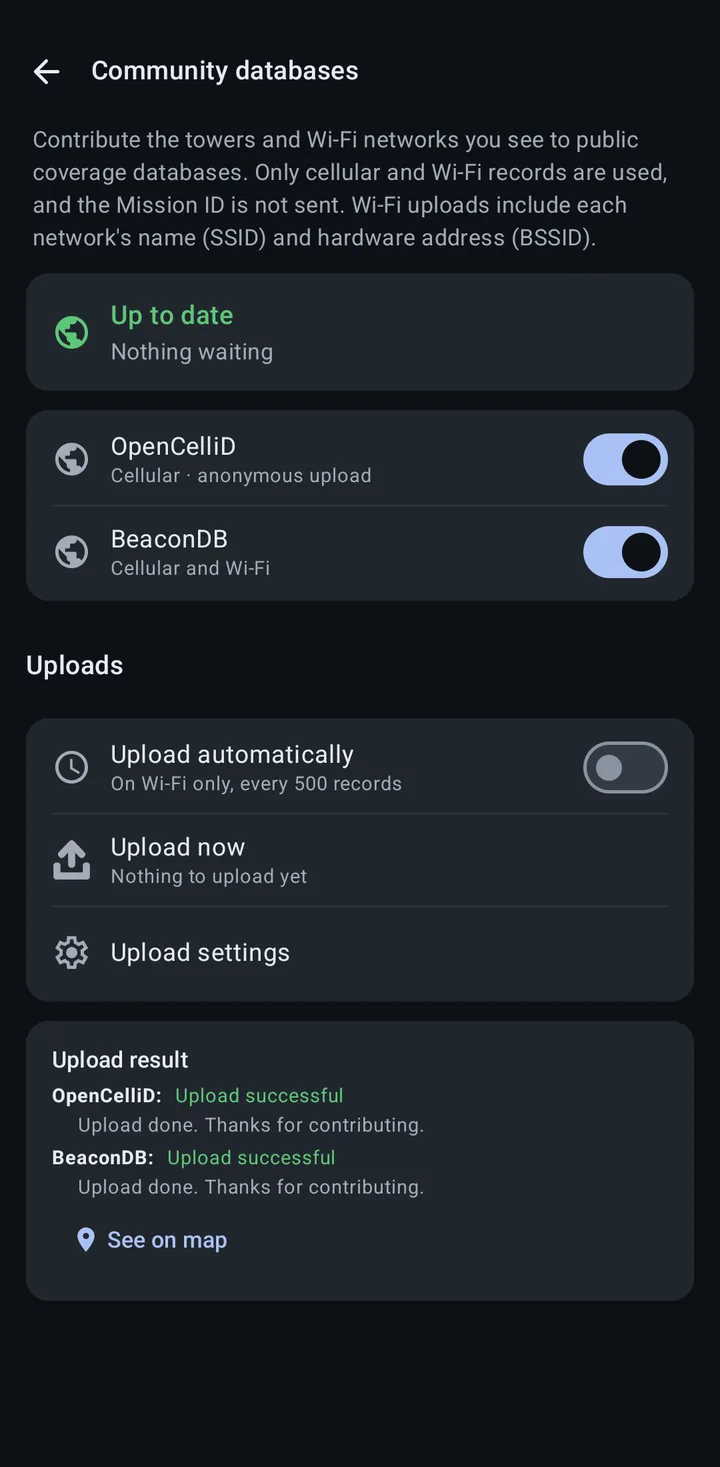
From the top:
- The intro: “Only cellular and Wi-Fi records are used, and the Mission ID is not sent. Wi-Fi uploads include each network’s name (SSID) and hardware address (BSSID).”
- Status: the same status as the Survey tab row, for example Up to date (“Nothing waiting”), Uploading, Waiting for internet or Will retry.
- OpenCelliD and BeaconDB switches: which databases get uploads. Both are on by default. The line under OpenCelliD says how uploads are signed: “Cellular · anonymous upload” or “Cellular · your API key”.
- Upload automatically: off by default. See Automatic uploads.
- Upload now: uploads what is waiting. Its line says how many records are ready, or “Nothing to upload yet”.
- Upload settings: more options; see Upload settings.
- Upload result: after an upload, the result for each database, with See on map to open the Map tab.
Uploading
Section titled “Uploading”Upload now
Section titled “Upload now”Tap Upload now to send the records that are waiting. By default the app first asks which databases to upload to, whether OpenCelliD uploads anonymously (only when you have saved a valid personal token), and whether to retry on failure; tick Don’t show this again to skip that question next time. (The question can be turned back on in Upload settings with Ask before each upload.)
Each database is uploaded to on its own. If one is down, the other still gets its records, and a database that already has a record doesn’t get it again.
Automatic uploads
Section titled “Automatic uploads”With Upload automatically on, the app uploads on its own during a survey after about every 500 new records saved for upload, and once more when the survey stops so nothing is left waiting. The page shows this as “On Wi-Fi only, every 500 records” (or “Every 500 records” when Upload on Wi-Fi only is off).
- Upload on Wi-Fi only (in Upload settings while Upload automatically is on; on by default) holds automatic uploads until the phone is on an unmetered network such as Wi-Fi.
- Automatic uploads also wait while the battery is low, and run at most about once every 15 minutes.
- They run in the background, even if you close the app.
- The switch is read when a survey starts. Turned on during a survey, it takes effect from the next one.
Retries
Section titled “Retries”With Retry failed uploads on (the default), a failed upload is tried again later. While it waits, the status says Will retry and the page offers Stop retrying.
What is saved for upload
Section titled “What is saved for upload”To keep the databases useful, the app does not save every record for upload:
- “Records are saved for upload when the survey starts and then each time you move 35 m, if location accuracy is within 100 m, so the count doesn’t grow while you stay in one place.”
- “Cells without a full identity, usually neighbor cells, are left out.”
- CDMA cells are not uploaded.
- Wi-Fi networks you exclude with Wi-Fi SSID exclusion are not saved for upload.
That is why the Survey tab’s Records panel can show a smaller “saved for upload” count for this destination, and why a survey indoors or standing still saves few records. Drive or walk outdoors with a good location fix for the best contributions.
What each database receives
Section titled “What each database receives”OpenCelliD (cellular): the location (latitude and longitude), the location accuracy, speed, the time the record was made, the radio type (GSM, UMTS, LTE or NR), the cell’s identity (MCC, MNC, LAC or TAC, and cell ID), the PSC (UMTS) or PCI (LTE and NR), the signal strength, the timing advance (GSM and LTE), and the phone model.
BeaconDB (cellular and Wi-Fi): the time the record was made, the position (latitude, longitude, accuracy, altitude, speed and location age) and, for each record:
- Cells: the radio type, MCC, MNC, LAC or TAC, cell ID, PSC or PCI, signal strength, timing advance (not UMTS), and whether it is the serving cell.
- Wi-Fi networks: the SSID (network name), BSSID (hardware address), channel, frequency, Wi-Fi standard, signal strength and signal-to-noise ratio when known.
Wi-Fi from an NS Scout goes to BeaconDB too, each record with its own location. Records that reach the phone late, such as what a Scout sends after it was out of range, and records without a nearby location fix are not uploaded. Wi-Fi clients and raw frames never go to either database.
Neither database receives the Mission ID, your device serial number, your phone number, or any call or text information.
Upload settings
Section titled “Upload settings”Open Upload settings from the Community databases page, or More > Settings > Destinations > OpenCelliD and BeaconDB uploads.
| Setting | Default | What it does |
|---|---|---|
| Ask before each upload | On | Shows the upload options before each Upload now |
| Retry failed uploads | On | Tries a failed upload again later |
| New tower alerts | Off | Notifies you when the phone connects to a tower that isn’t in OpenCelliD yet, during a survey that sends to the Community databases. See Map |
| Upload automatically | Off | Same switch as on the Community databases page |
| Upload on Wi-Fi only | On | Automatic uploads only on unmetered (Wi-Fi) networks. Shown while Upload automatically is on |
| Upload to OpenCelliD | On | Same as the OpenCelliD switch on the page |
| OpenCelliD personal access token | Not set | Your own OpenCelliD API key |
| Anonymous contribution | Off | Shown only when a valid personal key is saved |
| Upload to BeaconDB | On | Same as the BeaconDB switch on the page |
| Delete all data waiting to be uploaded | Deletes the records saved for upload from the phone |
OpenCelliD: anonymous or your own key
Section titled “OpenCelliD: anonymous or your own key”OpenCelliD uploads work without an account:
- Without a personal access token, uploads are anonymous, using a shared token built into the app (“Not set · uploads are anonymous”).
- With your own token, uploads are made under your OpenCelliD account, so your contributions are credited to you. Create an account at opencellid.org, copy your access token, and enter it under OpenCelliD personal access token. With a valid token saved, Anonymous contribution appears (off by default); turn it on to upload anonymously while keeping your token saved.
If OpenCelliD refuses your key, the status shows Key refused (“OpenCelliD refused the API key”). Check the token in Upload settings.
BeaconDB
Section titled “BeaconDB”BeaconDB needs no account or key.
Managed phones
Section titled “Managed phones”On a phone with any managed configuration (MDM), uploads to the community databases are blocked unless the organization sets allow_external_data_upload to true. The Community databases page then says “Your organization does not allow uploads to public databases on this phone.” and the destination is not offered on the Survey tab. “Override organization settings” does not lift this. See MDM configuration.
Related
Section titled “Related”- Wi-Fi SSID exclusion: keep networks out of every destination
- Map: towers on the map, My survey points and new tower alerts
- Cellular networks: understanding tower data
- Wi-Fi networks: understanding Wi-Fi data
- Privacy policy: data handling