Bluetooth devices
Network Survey scans for both Bluetooth Classic and Bluetooth Low Energy (BLE) devices and collects signal strength, device information, and identifiers.
The full list of fields in a Bluetooth record is defined in the NS Messaging API documentation.
Bluetooth technologies
Section titled “Bluetooth technologies”| Technology | Year | Range | Power |
|---|---|---|---|
| Bluetooth Classic | 1999 | 10-100m | Higher |
| Bluetooth Low Energy (BLE) | 2010 | 10-50m | Very low |
Network Survey scans for both.
The Bluetooth list
Section titled “The Bluetooth list”Open Signals and pick Bluetooth. The list needs Bluetooth on, the Nearby devices and Location permissions (Location only, before Android 12), and location turned on. If something is missing, the list says what and offers the button that fixes it.
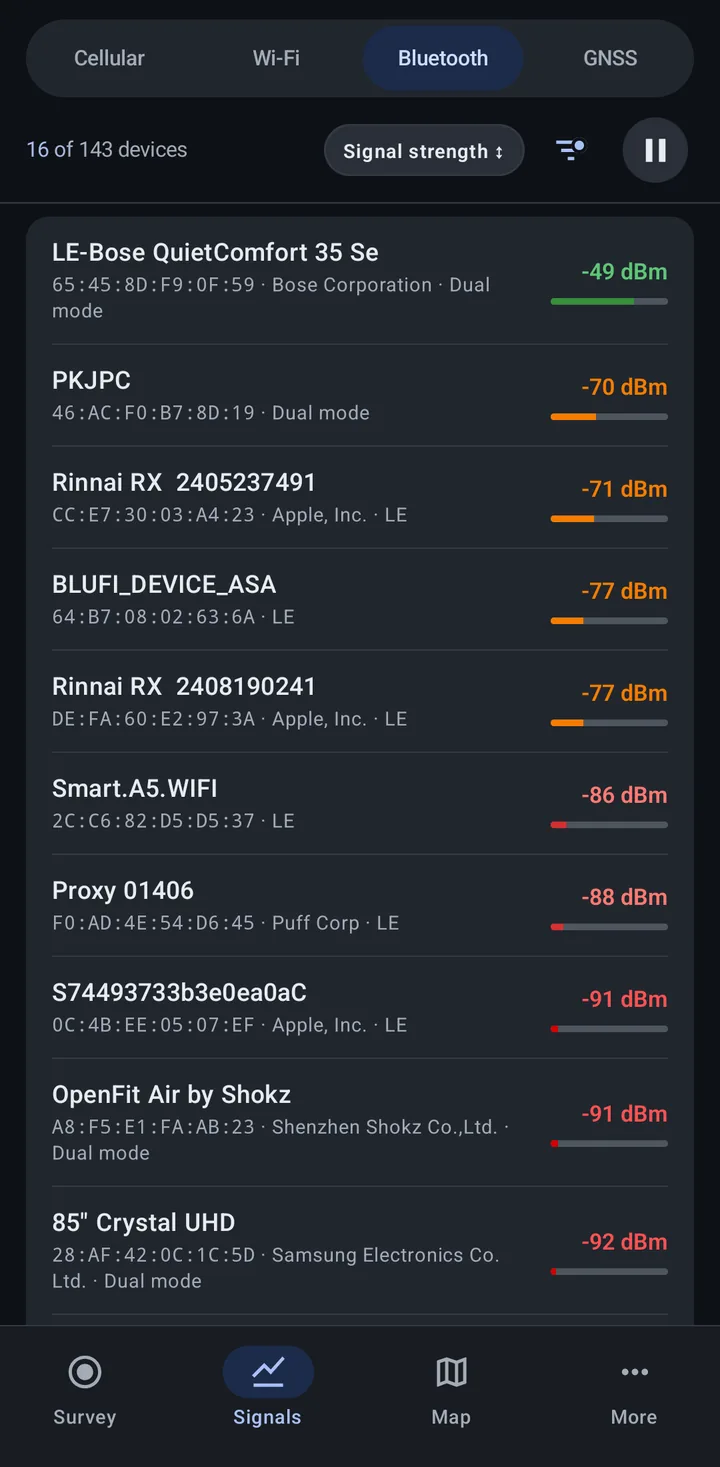
The line at the top shows how many devices the list holds (“143 devices”, or “16 of 143 devices” while a filter is on), followed by:
- Sort: by Signal strength, Address, Name, or Technology.
- Filter: opens Filter devices (see below). The button shows a dot while a filter is on.
- Pause updates: freezes the list while you read it. It does not pause a survey.
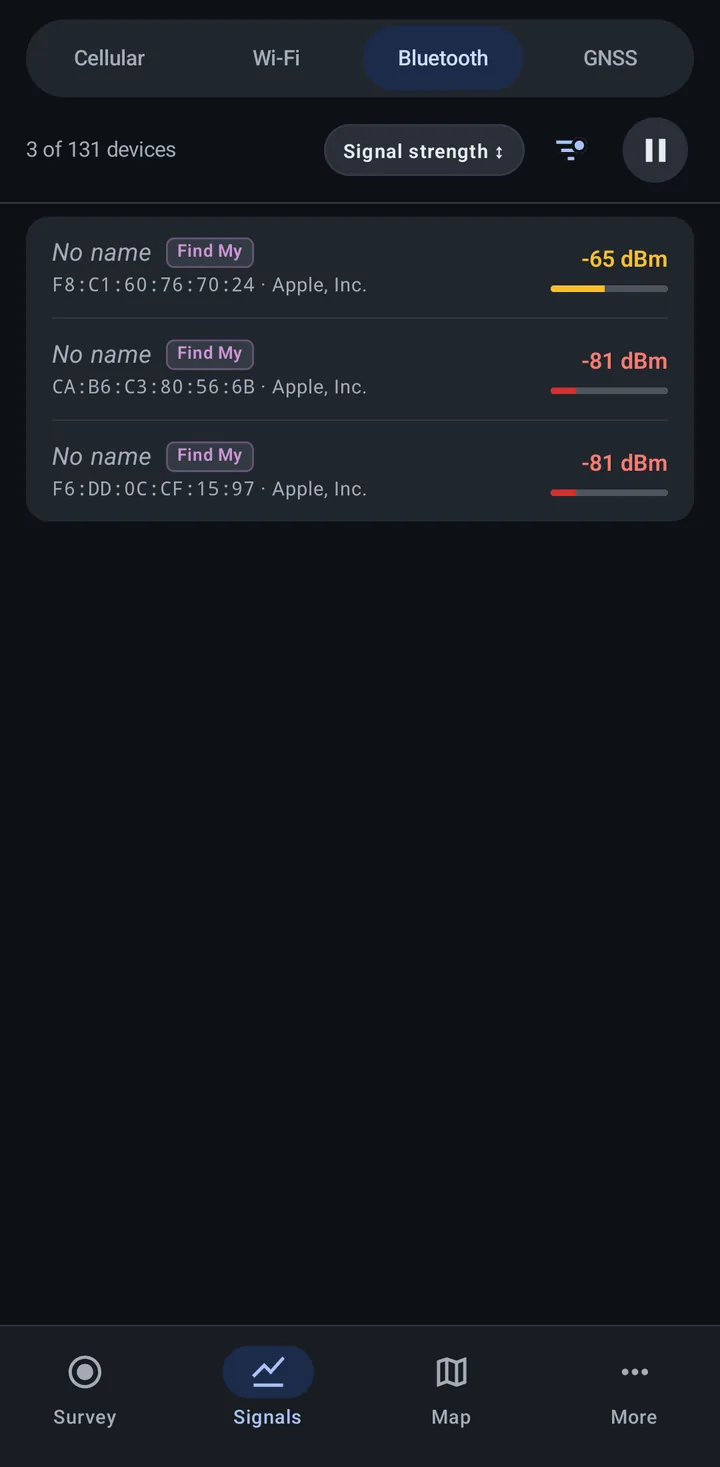
Each row shows the device’s name (or “No name” when it has not broadcast one), a tracker tag when it is one, and then the address, the company, and the technology when known: LE, BR/EDR (Classic), or Dual mode. The signal is on the right.
The company comes from the Bluetooth company ID and service UUIDs in the device’s advertisement, which the app looks up in data bundled with the app.
Tap a row to open its details. Long-press a row to copy the address.
Filter devices
Section titled “Filter devices”The Filter devices sheet has a search box (Search name, address or company) and two switches:
- Named only hides devices that have not broadcast a name.
- Trackers only shows only devices tagged as Find My trackers.
The address search also ignores the : and - separators. The filter changes the display only. It does not affect what is logged, streamed, or uploaded, and it resets when the app restarts.
Find My trackers
Section titled “Find My trackers”Every Apple Find My device (iPhones, Macs, AirPods, AirTags, and third-party Find My accessories) sends Apple’s company ID with a Find My payload, so the company alone does not mean a tracker. Network Survey reads the device type bits in the payload’s status byte and tags the row:
- AirTag: a first-generation AirTag.
- Find My: a third-party Find My tracker or accessory, a second-generation AirTag, or some AirPods. These can only be told apart by connecting to the device, which a passive survey does not do.
iPhones, iPads, Macs, Apple Watches, and AirPods that report themselves as AirPods are not tagged as trackers. So an AirTag can show as Find My rather than AirTag, and Trackers only shows both tags.
Bluetooth device details
Section titled “Bluetooth device details”Tapping a device opens Bluetooth device details, with the fields the device reported:
- Technology, Address type, Device class, Company ID, Service UUIDs, Manufacturer data, and Tx power
- Find My type for a Find My device: Apple device, AirTag, Tracker or accessory, or AirPods
- Manufacturer: a name reconciled from the Bluetooth company ID, the service UUIDs, and, when Manufacturer lookup is on, the address’s OUI
- Signal · last 2 minutes: a chart of the device’s signal
Service UUIDs and company IDs
Section titled “Service UUIDs and company IDs”BLE devices advertise the services they provide, for example:
0x180F: Battery Service0x180A: Device Information0x180D: Heart Rate Service0x181A: Environmental Sensing0xFEAA: Eddystone beacon
They also send a company ID that names the manufacturer, for example 0x004C (Apple), 0x0006 (Microsoft), 0x00E0 (Google), and 0x0075 (Samsung).
Full lists: Bluetooth SIG Assigned Numbers.
Signal strength
Section titled “Signal strength”The list colors each signal on the same five steps as Wi-Fi: Strong above -60 dBm, Good -60 to -70 dBm, Fair -70 to -80 dBm, Weak -80 to -90 dBm, and Very weak below -90 dBm.
Signal strength gives a rough idea of distance, but obstacles, interference, and each device’s transmit power all change it, so it cannot be turned into an exact distance.
Scan interval
Section titled “Scan interval”The Bluetooth scan interval defaults to 30 seconds, and the minimum is 24 seconds. Each cycle runs:
- a 10 second BLE scan
- a 12 second Classic scan
- a 1 second buffer so the Classic scan finishes
- at least a 1 second wait before the next cycle
That adds up to the 24 second minimum. A shorter setting behaves the same as 24 seconds. Change the interval in Settings > Scan rates; see Scan rates.
Permissions
Section titled “Permissions”Android 12 and later: the app asks for Nearby devices, which covers BLUETOOTH_SCAN (find devices) and BLUETOOTH_CONNECT (read device names), plus Location. Scanning works without BLUETOOTH_CONNECT, but then the app only gets the names devices put in their BLE advertisements, so Bluetooth Classic names and other names are missing; addresses are still captured.
Android 11 and earlier: the app uses BLUETOOTH and BLUETOOTH_ADMIN, which need no prompt, plus Location. Device names work without an extra grant.
See Required permissions for details.
Use cases
Section titled “Use cases”- Asset tracking: survey BLE beacons in a warehouse and watch them over time
- IoT discovery: find BLE sensors and smart home devices, and measure device density
- Privacy checks: spot Find My trackers nearby
- Site surveys: check signal coverage and find interference
Related
Section titled “Related”- Network technologies overview: the Signals tab
- OUI lookup: look up a MAC address manufacturer
- Required permissions: Bluetooth permission details
- Scan rates: the Bluetooth scan interval